
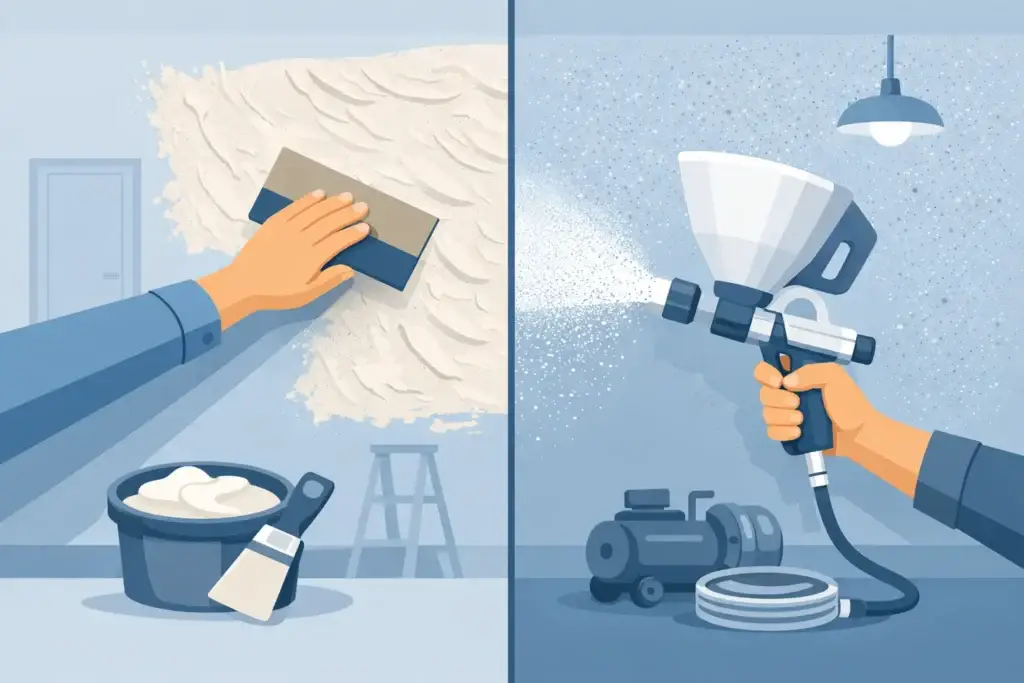
If you are choosing between hand texture vs spray texture, the right answer usually comes down to two things – the look you want and how the room needs to perform over time. Texture is not just a cosmetic decision. It affects how walls catch light, how repairs blend in, how quickly a project moves, and how polished the final space feels.
For homeowners, property managers, and builders, that choice matters more than people expect. A texture finish can help hide imperfections, create a cleaner updated look, or match the rest of the property during repairs and remodeling. But hand-applied and spray-applied textures do not behave the same way, and one is not automatically better than the other.
Hand texture vs spray texture: what is the difference?
Hand texture is applied manually with tools like a trowel, knife, hawk, or brush. The finisher controls the pattern by hand, which creates a more custom look with variation and depth. Depending on the style, hand texture can look subtle and refined or more decorative and dramatic.
Spray texture is applied with a hopper gun or sprayer, then sometimes knocked down or left as sprayed depending on the finish. Common spray textures include orange peel, splatter, and knockdown. Because the material is sprayed across the surface, coverage is faster and the texture pattern is often more uniform from wall to wall.
The main difference is control versus speed. Hand texture gives the finisher more room to shape the surface intentionally. Spray texture covers more area quickly and works well when consistency and production matter.
When hand texture makes more sense
Hand texture is often the better fit when the finish itself is part of the design. In a custom home, a remodel with character, or a room where the walls are meant to add visual interest, hand-applied texture can bring a level of craftsmanship that machine spraying cannot fully copy.
It is also useful when a space has uneven surfaces that need a little more finesse. Because the installer is working directly with the wall, small transitions and imperfections can often be managed more carefully. That can be valuable in older homes or in areas where patching and blending need a more tailored approach.
Another advantage is individuality. No two hand-textured walls are exactly alike. For some clients, that is the appeal. The finish feels less manufactured and more custom built.
The trade-off is time. Hand texture takes longer to apply, and that usually means higher labor cost. It also requires real skill to look intentional rather than inconsistent. A rushed or inexperienced hand texture job can end up looking messy instead of custom.
When spray texture is the better choice
Spray texture is the practical choice for many modern drywall projects because it is efficient and reliable. If you are finishing a full house, a large commercial space, or multiple rooms on a schedule, spraying can save significant time while still delivering a clean professional result.
Spray-applied finishes also tend to be the easiest way to create a uniform look across broad surfaces. That matters in new construction, rental turnovers, and straightforward remodels where consistency is more important than artistic variation.
For many Oklahoma homes, spray textures like orange peel or knockdown are familiar, durable options that fit the style of the property without calling too much attention to themselves. They help soften minor drywall imperfections and give painted walls a finished appearance.
The trade-off here is customization. Spray texture can look great, but it usually has a more standardized feel. It also requires careful masking and prep because overspray can travel fast if the work area is not properly protected.
Appearance: which one looks better?
This is where personal preference takes over. Hand texture usually has more depth, variation, and character. It can make a room feel warmer or more detailed, especially when paired with the right paint sheen and lighting. In the right setting, it adds craftsmanship you can see.
Spray texture tends to look cleaner and more uniform. That can be a real advantage if you want a simple finish that does not compete with other design elements like cabinetry, flooring, or trim. It often fits best in spaces where the goal is a neat, updated, low-maintenance surface.
Lighting matters too. Strong natural light or directional lighting can exaggerate texture. Heavy hand texture may cast more shadow and show more movement on the wall. A lighter spray texture can feel more subtle in those same conditions. That is why the best choice is not just about the texture itself, but about the whole room.
Cost and labor considerations
In most cases, spray texture is more cost-effective for larger areas. The application is faster, and production speed helps control labor costs. If you are working within a budget and need to cover a lot of square footage, spray texture often makes financial sense.
Hand texture usually costs more because it takes more time and a higher level of manual finish work. For a feature area or select rooms, that added cost may be worth it. For an entire property, it depends on the budget and the finish standard you are aiming for.
Repairs can affect cost as well. If you are matching an existing texture, the cheapest option is not always the right one. A mismatch on a visible repair can stand out every time you walk past it. In those cases, paying for the correct method often saves frustration later.
Repairs and touch-ups over time
One of the biggest practical questions is how each texture handles future drywall repair. This matters after plumbing access, settling cracks, accidental damage, or remodeling work.
Spray texture can be easier to reproduce in standard patterns, especially when the original finish is common and the surrounding area is not heavily worn or painted many times over. That said, matching any sprayed texture still takes experience. The size of the droplets, material thickness, air pressure, and knockdown timing all affect the final look.
Hand texture can be trickier or easier depending on the pattern and the finisher. A highly custom hand-applied texture may take real craftsmanship to blend well, but that same direct hand control can also help in smaller repair areas where precision matters.
The real answer is that neither one is automatically easy to patch. What matters most is whether the person doing the repair understands how to match the existing finish instead of simply covering the damage.
Best uses for different spaces
In living rooms, entryways, and other visible areas, hand texture can add a custom touch if the home style supports it. In bedrooms, hallways, offices, and larger general-use spaces, spray texture often gives a clean dependable finish without slowing down the project.
For commercial properties, spray texture is often the stronger fit because it supports speed, consistency, and easier large-scale execution. For custom residential remodels, hand texture may be worth considering where the finish is meant to stand out.
Bathrooms, kitchens, and high-traffic areas depend more on proper prep, quality materials, and paint selection than on whether the texture was sprayed or applied by hand. Texture plays a role, but durability starts with sound drywall work underneath.
How to choose the right texture for your project
The best decision usually comes from asking a few straightforward questions. Are you trying to match an existing wall or create a new look? Do you want subtle and consistent, or more custom and expressive? Is the project driven by schedule, budget, appearance, or all three?
If speed, uniformity, and value are the priorities, spray texture is often the right move. If the goal is a more distinctive finish with a handcrafted look, hand texture may be worth the extra labor. And if you are repairing damaged drywall, matching the current texture should lead the decision more than personal preference.
A dependable drywall contractor should be able to walk you through those trade-offs clearly, not push a one-size-fits-all answer. At KCS Drywall, that means looking at the condition of the walls, the style of the property, the size of the job, and the finish you want before recommending the right approach.
Texture should support the space, not fight it. The best finish is the one that looks right on day one and still makes sense years later when the room gets repainted, repaired, or updated again.