
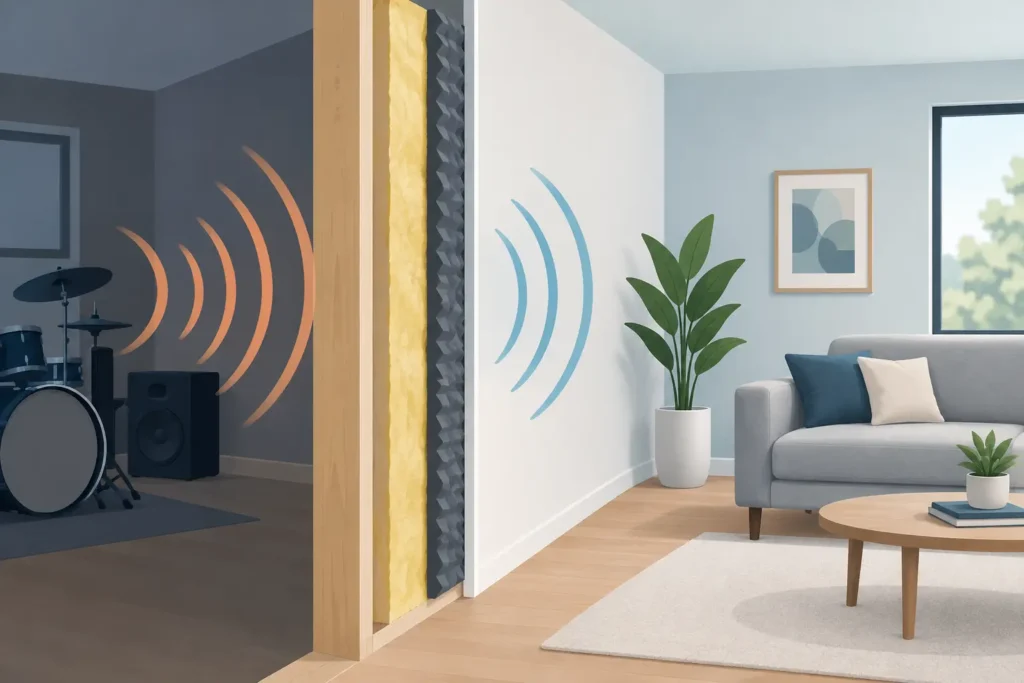
A wall can look finished and still do very little to stop sound. If you can hear every phone call from the home office, a television through a bedroom wall, or normal conversation between apartments, interior wall soundproofing can make the space more comfortable and more private.
The right solution depends on what you hear, how the wall is built, and how much disruption the project can allow. A thin interior partition needs a different approach than a wall with plumbing, electrical boxes, or an existing textured finish. The goal is not to add material at random. It is to build a wall assembly that blocks, absorbs, and limits the paths sound uses to travel.
Why Sound Travels Through Interior Walls
Most interior walls are built for separation, not sound control. A standard wall may have wood or metal studs, drywall on each side, and an empty cavity in between. That construction is perfectly suitable for many rooms, but voices, music, television noise, and other airborne sounds can pass through the drywall, the open stud cavity, and even small gaps around outlets or doors.
Sound also moves through connected building materials. This is called structure-borne sound. A speaker against one wall, a washing machine vibration, or footsteps on an upper floor can send vibration through framing and into nearby rooms. Adding a single layer of drywall may reduce some noise, but it will not solve every source of sound transmission.
That is why successful sound control starts with an honest assessment. Is the main problem conversation from the next room? Is it bass-heavy music? Is sound leaking through a hollow-core door instead of the wall itself? A professional inspection can keep the project focused on the part of the room that needs attention.
Interior Wall Soundproofing Starts With the Wall Assembly
Effective interior wall soundproofing usually combines several methods. Each one addresses a different weakness in the wall. The best choice balances performance, budget, wall thickness, and the condition of the existing finish.
Add insulation inside the cavity
When a wall is open during remodeling or repair, mineral wool or sound-control fiberglass insulation is often one of the smartest upgrades. Unlike standard thermal insulation alone, these products are designed to absorb airborne sound inside the stud cavity. They can noticeably reduce voices, television noise, and everyday activity moving between rooms.
Insulation does not block sound by itself. It works best as part of a complete wall system with properly installed drywall and sealed gaps. Still, if drywall is already being removed for electrical work, water damage repair, or a remodel, adding acoustic insulation is a practical opportunity that is difficult to recreate later without opening the wall again.
Add mass with another layer of drywall
More mass generally makes it harder for sound to pass through a wall. Installing an additional layer of drywall can improve sound reduction, particularly for speech and mid-range noise. In many homes, a layer of 5/8-inch drywall provides more sound control than standard 1/2-inch drywall because of its added density.
The trade-off is that another drywall layer adds weight and slightly reduces room dimensions. It may also require adjustments at electrical boxes, trim, door jambs, and window returns. A qualified drywall crew can plan for those details so the finished wall looks intentional rather than patched together.
Decouple the drywall from the framing
For higher-performance rooms, decoupling is often the difference between a modest improvement and a meaningful one. Resilient channels, sound isolation clips, or a separately framed wall reduce the direct connection between drywall and studs. With less direct contact, less vibration transfers through the framing.
Decoupling is especially helpful for media rooms, bedrooms beside busy common areas, conference rooms, and multi-family properties. It costs more than simply adding drywall, and installation details matter. A misplaced screw that connects the drywall directly to a stud can reduce the benefit of the entire system. This is work that rewards careful planning and precise installation.
Seal air gaps with acoustical sealant
Small openings can undermine a well-built wall. Sound moves through air, so gaps around electrical boxes, baseboards, wall penetrations, and drywall edges can become weak points. Acoustical sealant remains flexible and helps close those openings without cracking as the home naturally moves.
This step is often overlooked because the gaps may be hidden behind trim or outlet covers. It is also one of the most cost-effective parts of a sound-control project. Sealing alone will not stop loud music, but it can make a surprising difference for speech and everyday household noise.
Match the Solution to the Noise Problem
Not all unwanted sound behaves the same way. Clear speech, barking dogs, and television dialogue are usually easier to improve with insulation, added drywall, and good sealing. Low-frequency sound from subwoofers, traffic vibration, or heavy equipment is more difficult because bass energy travels through both air and structure.
If privacy is the priority, focus on the wall assembly and any openings around it. If the goal is a quieter home office, do not ignore the door. A solid-core door with perimeter seals can outperform an expensive wall upgrade when the existing door is hollow and loose-fitting. The same is true for return-air vents, recessed lighting, and shared ceiling cavities, which may provide sound with an easier route around the wall.
For commercial offices, property managers and builders should also consider the expected use of the space. A private counseling office, medical exam room, executive office, or conference room may need more than a standard partition. Planning sound control before framing and drywall installation is usually more affordable and less disruptive than retrofitting after tenants move in.
When Opening the Wall Makes Sense
Opening an existing wall is not always necessary, but it often produces the best result when a project needs insulation, wiring changes, or stronger isolation. It is particularly worthwhile during a kitchen or bathroom remodel, after a leak repair, or when renovating a room that will serve a new purpose.
A partial wall opening may be enough if the problem is limited to one area. For example, a shared bedroom wall can be opened, insulated, sealed, and refinished without disturbing the entire room. If the drywall is in poor condition or the texture needs updating anyway, a more complete upgrade can provide a cleaner, more consistent result.
There are also surface-applied options for walls that should remain intact. An extra drywall layer with damping compound and careful perimeter sealing can improve performance without removing the original board. This approach has limitations, especially when sound is traveling through doors, ceilings, or side walls, but it can be a sensible choice when demolition needs to stay minimal.
Do Not Let Finishing Details Undo the Work
Soundproofing materials only perform as well as the installation behind them. Gaps in insulation, unsealed drywall edges, poorly treated outlet openings, and rushed finishing can all reduce the value of the upgrade. Clean drywall work matters because the wall must be flat, secure, properly taped, and ready for a durable finished surface.
Texture and paint also deserve consideration. If one wall is opened and repaired, matching the surrounding texture takes experience. A repair that controls sound but leaves a visible patch is not a complete solution. Homeowners should expect both better room performance and a finish that blends with the rest of the space.
Before work begins, ask what will be opened, how electrical boxes and trim will be handled, whether the plan addresses doors and vents, and what finish will be restored afterward. Clear answers help prevent change orders and make it easier to compare proposals fairly.
A Better Quiet Starts With a Practical Plan
There is no single product that makes every wall silent. The most reliable results come from identifying the noise path, choosing the right combination of insulation, mass, separation, and sealing, then finishing the work with care. For Oklahoma homeowners and property owners, that can mean a more restful bedroom, a more productive office, or a space that simply feels better to live and work in.
KCS Drywall approaches these upgrades the same way it approaches any wall repair or remodel: with clear communication, clean workmanship, and attention to the details hidden behind the finished surface. A thoughtful plan now can save you from living with the same noise problem after the paint dries.