
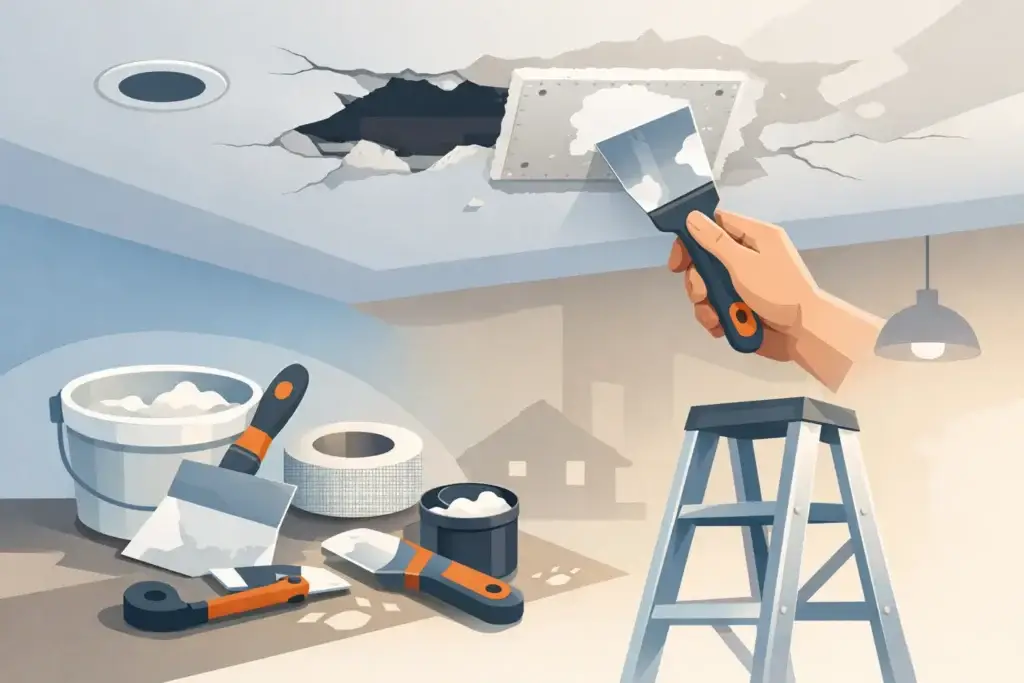
A ceiling flaw gets noticed fast. Hairline cracks, popped screws, sagging tape, or a hole from a leak can make the whole room feel unfinished, even if the rest of the space looks fine. If you are wondering how to repair ceiling drywall, the right approach depends on what caused the damage, how big it is, and whether the ceiling is still dry and structurally sound.
Ceiling repairs are different from wall repairs for one simple reason – gravity works against you the entire time. A quick patch that might hold on a wall can fail overhead if it is not properly supported, fastened, taped, and finished. That is why good prep matters just as much as the patch itself.
Before you repair ceiling drywall, find the cause
The first step is not mud or tape. It is figuring out why the damage happened. A brown stain, soft spot, or bubbling paint often points to a roof leak, plumbing issue, or HVAC condensation problem. Cracks along seams can come from framing movement, settling, or a poorly finished joint. Nail or screw pops usually mean the drywall has shifted slightly away from the framing.
If moisture caused the problem, stop there until the source is fixed and the area is fully dry. Patching over damp drywall usually leads to mold, staining, or a failed repair. If the ceiling feels soft, crumbles easily, or sags between framing members, replacement is usually the safer choice.
For homes in Oklahoma, this matters even more after storms, roof wear, or seasonal movement. A clean finish starts with a stable surface.
Know what type of ceiling damage you have
Small cosmetic damage is the most straightforward. That includes hairline cracks, minor dents, and isolated screw pops. These can often be repaired with joint compound, a little sanding, and touch-up paint.
Medium damage usually means separated tape, wider cracks, or holes up to several inches across. These repairs need better reinforcement, not just filler. Mesh or paper tape, proper backing, and multiple coats become more important here.
Large damage is different. If a section is broken through, water-damaged, sagging, or missing entirely, the repair often involves cutting back to sound drywall and installing a new piece. Once the patch gets bigger, the work shifts from cosmetic repair to partial replacement.
Tools and materials that make the job easier
You do not need a full construction trailer to handle a basic ceiling repair, but you do need the right materials. Most jobs call for a utility knife, drywall saw, drill or driver, drywall screws, joint compound, a taping knife, sanding sponge, and primer. For holes, you may also need a drywall patch or a fresh piece of drywall cut to fit.
For tape repairs, paper tape usually gives a stronger finish on flat seams, while self-adhesive mesh tape can be useful for small patch areas. Lightweight compound sands easier, but setting-type compound can be a better choice when strength and faster drying matter. It depends on the repair and how comfortable you are working overhead.
A sturdy step ladder, drop cloths, and eye protection are worth having too. Ceiling sanding creates more dust than most people expect.
How to repair ceiling drywall cracks and popped fasteners
If the issue is a narrow crack, start by scraping away any loose paint, loose compound, or damaged tape. Widening the crack slightly with a utility knife can help the new compound bond better. If the crack runs along a seam and the old tape has lifted, remove the loose section rather than trying to bury it.
For screw pops, press on the area first. If the drywall moves, drive a new drywall screw into solid framing about an inch or two away from the popped fastener. Then remove or reset the popped one. Simply covering it with mud will not solve the movement underneath.
Apply a thin bed of compound, embed tape if needed, and smooth it out with a taping knife. Let it dry completely before adding a second coat. Most ceiling repairs look better with at least two or three thin coats rather than one thick one. Thick mud shrinks, cracks, and takes longer to sand smooth.
How to repair a small hole in ceiling drywall
For a small hole from impact damage or an old fixture, begin by trimming away any loose edges. If the drywall around the hole is solid, a patch can work well. Some homeowners use ready-made patch kits, but they are best for very small holes. For anything larger, a drywall patch with backing support usually gives a flatter, stronger result.
One reliable method is to cut the damaged area into a neat square or rectangle. Then place wood backing strips above the opening, screw them in place through the existing drywall, and fasten a new drywall piece to those supports. That keeps the patch from shifting and helps it sit flush with the surrounding ceiling.
Once the patch is secure, tape the seams and apply joint compound in thin coats. Feather each coat wider than the last so the repaired area blends into the rest of the ceiling. This is where patience pays off. A patch can be structurally solid and still look obvious if the edges are not feathered well.
How to repair larger ceiling drywall sections
If the damaged area is large, stained through, or sagging, replacing the affected section is often the better move. Cut back to clean, solid drywall, ideally ending your cuts at framing where possible. If the new drywall edges do not land on framing, add support blocking so every edge of the patch can be fastened securely.
Measure carefully and use drywall that matches the existing ceiling thickness. A mismatch can leave a visible hump or dip that is hard to hide later. After fastening the new section, tape all joints and build out the finish gradually with compound.
This part is where many DIY repairs start to show. Ceilings catch light differently than walls, especially near windows or recessed lighting. Even small waves, ridges, or sanding marks can stand out once the paint dries. That does not mean a homeowner cannot do the work, but it does mean the finish stage deserves extra attention.
Matching ceiling texture is often the hardest part
On a smooth ceiling, the goal is a flat, invisible finish. On a textured ceiling, the challenge is matching what is already there. Orange peel, knockdown, and hand textures all require different methods, and even when the pattern is close, the repair can still flash if the paint sheen is different.
If the ceiling has texture, test your technique on scrap cardboard first. Trying to learn the spray pattern or knife pressure directly on the ceiling usually leads to rework. For older ceilings, exact texture matching can be difficult because years of paint buildup change the appearance.
A good repair is not just about filling the damage. It is about making the surface look consistent from one side of the room to the other.
Sanding, priming, and painting the repair
After the final coat of compound dries, sand lightly and check the surface from different angles. Side lighting helps reveal ridges and low spots. If you still see a seam, apply another thin coat instead of trying to sand the problem away aggressively.
Always prime new compound before painting. Primer seals the patch so the finish paint dries evenly. Without it, the repaired area can absorb paint differently and leave a dull spot or visible ring.
If only a small area was repaired, touch-up paint may work, but ceiling paint often ages or fades over time. In many cases, repainting the full ceiling gives the cleanest result.
When to handle it yourself and when to call a pro
Small cosmetic repairs are often manageable if the drywall is dry, stable, and easy to reach. If you are dealing with active moisture, sagging material, repeated cracking, large patches, or texture blending across a visible ceiling plane, professional repair usually saves time and frustration.
That is especially true in living rooms, entryways, and commercial spaces where the ceiling finish is easy to see. A repair overhead has to do more than hold. It has to disappear.
For property owners who want the job done cleanly and on schedule, working with an experienced drywall contractor can make the difference between a patch that looks acceptable and one that looks original. At KCS Drywall, that is the standard.
A ceiling repair may seem small, but it affects the way the whole room looks. Take the time to fix the cause, use the right method for the damage, and do not rush the finish work. That is what turns a patch into a repair you do not have to think about again.