
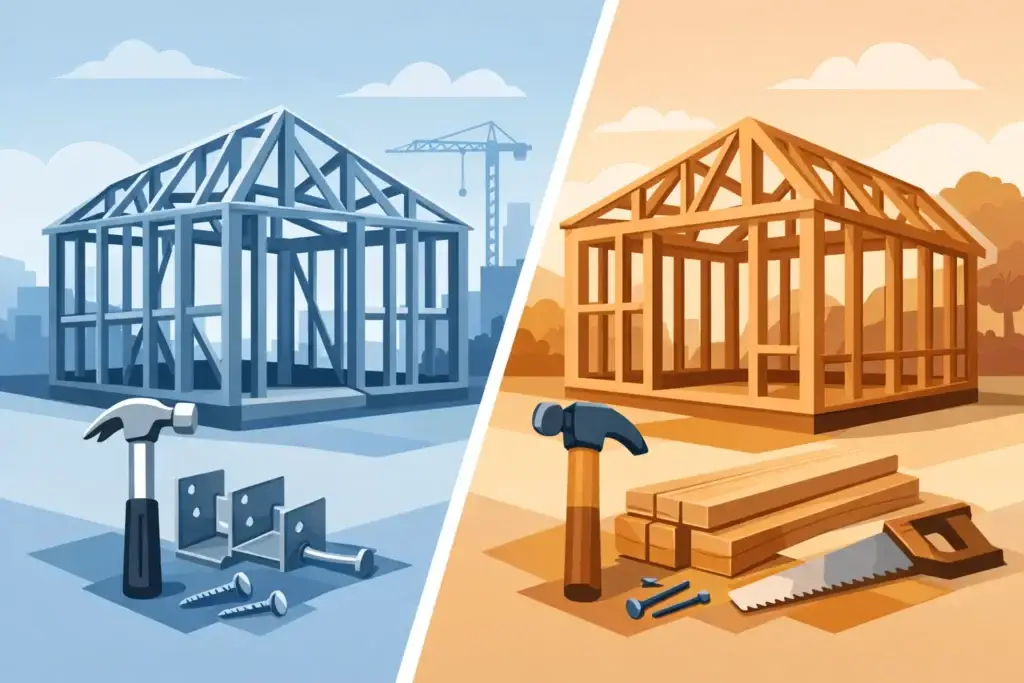
If you’re planning a remodel, tenant finish-out, or new interior build, metal framing vs wood framing is one of the first choices that affects cost, durability, and how smoothly the job moves. The right answer depends on the building, the environment, and the kind of finish you expect when the drywall goes up.
At a glance, wood feels familiar. Metal feels more commercial. But that simple view misses the real question: which material gives you the best long-term result for your specific project?
Metal framing vs wood framing: what really changes
Framing is the skeleton behind the walls. It affects how straight those walls stay, how they respond to moisture, how easy it is to run utilities, and how predictable the finished surface looks once drywall, texture, and paint are complete.
For homeowners, the decision often comes up during basement finishes, room additions, garage conversions, and interior remodels. For commercial clients, metal framing is often part of standard practice, especially in office interiors, retail spaces, and tenant improvements. The material choice shapes scheduling, labor, repairs, and performance over time.
Wood framing uses dimensional lumber, typically studs and plates cut and fastened on site. Metal framing uses cold-formed steel members that are light, straight, and built for interior partition systems and some structural applications. Both can work well when installed correctly. Problems usually come from choosing the wrong system for the conditions or from poor workmanship during installation.
Where wood framing still makes sense
Wood remains a practical choice for many residential projects. It’s widely available, familiar to most trades, and often easier to modify in the field. If a layout changes or a framing member needs adjustment, wood can be cut, shimmed, and fastened with basic tools. That flexibility matters on remodels where existing walls, uneven floors, or older construction can create surprises.
Wood can also be cost-effective depending on market pricing and project scope. On smaller residential jobs, labor may move faster with wood because crews are used to it and coordination with other trades is straightforward. Hanging cabinets, trim, and wall-mounted items can also feel more intuitive when backing and fastening are planned around lumber.
That said, wood has trade-offs. It can warp, twist, shrink, or expand as conditions change. In Oklahoma, where temperature swings and humidity shifts are part of life, that movement can show up later as nail pops, uneven drywall seams, or subtle wall irregularities. None of that means wood is a bad material. It means quality lumber selection and proper installation matter a lot.
Why metal framing is often the better fit indoors
Metal framing brings consistency. Steel studs are manufactured to uniform dimensions, so walls tend to go up straighter and stay straighter. That can make a real difference in drywall finishing, especially on long runs of wall where bows and crowns are easier to spot once light hits the surface.
Metal also handles moisture better than wood in one important sense: it does not absorb water and swell the way lumber can. In areas where humidity, minor moisture exposure, or climate control issues are a concern, that stability can be a major advantage. It will not rot, and termites are not a factor.
Fire resistance is another reason many commercial projects lean toward metal framing. The framing itself is noncombustible, which can help support code requirements depending on the wall assembly and building type. For offices, retail build-outs, and multi-unit properties, that can make metal the more practical route from the start.
Still, metal is not automatically better in every setting. It requires a crew that knows how to frame it correctly, brace it properly, and coordinate details for drywall attachment, backing, and penetrations. Poor metal framing can create just as many finish issues as poor wood framing.
Cost depends on more than material price
One of the biggest mistakes property owners make is comparing only the raw cost of studs. Material price matters, but it is only one part of the total.
Labor, tool requirements, waste, jobsite conditions, and project complexity all affect the final number. On some jobs, wood may look cheaper at first but require more correction because of bowed lumber or field adjustments. On other jobs, metal may have a higher learning curve or slower production if the crew is not set up for it.
Commercial interiors often favor metal because the workflow is predictable and the framing integrates well with standard suspended ceilings, non-load-bearing partitions, and drywall systems. Residential remodels may favor wood when tying into existing construction or when structural modifications are involved.
The better question is not, “Which is cheaper?” It is, “Which system gives this project the best result without creating extra repair or finish issues later?”
Performance behind the drywall
This is where the choice becomes more practical than theoretical. If your goal is clean, durable walls, framing quality matters just as much as the finish coat.
Straight framing makes drywall installation easier and helps create flatter surfaces. Metal has an edge here because it arrives straight and uniform. Wood can deliver great results too, but only when the lumber is well selected and the framing is corrected as needed during installation.
Sound can also play a role. Metal studs can transmit vibration differently than wood, so wall assembly design matters if privacy is important in offices, bedrooms, or shared spaces. Insulation, drywall layers, and resilient components often have more impact than the framing material alone, but it’s worth discussing early if acoustics matter.
For hanging heavy items, both systems can work with proper backing. That part is often overlooked. Whether you’re mounting cabinets, TVs, shelving, or commercial fixtures, planning for support during framing is what prevents headaches later.
Which framing material fits common projects?
For many residential interior remodels, wood is still a solid option, especially when matching existing framing or making structural changes. It is familiar, adaptable, and often a practical fit for additions and traditional home construction.
For commercial interior build-outs, office partitions, retail spaces, and non-load-bearing walls, metal framing is often the smarter choice. It is straight, consistent, resistant to pests, and commonly expected on professional jobsites.
For areas with moisture concerns, metal often has the advantage, but the full wall system still needs to be designed correctly. Moisture-resistant drywall, proper ventilation, and good detailing matter just as much as the stud material.
For projects where finish quality is the priority, either can perform well if the framing is done right. That is the key point. A good drywall result starts with a well-built wall.
Metal framing vs wood framing in Oklahoma conditions
Local conditions matter. Oklahoma properties deal with humidity swings, seasonal temperature changes, and in some cases shifting structures. Those factors can stress framing over time.
Wood can respond to those changes by moving more, especially if moisture content is not controlled before installation. Metal is more dimensionally stable, which can help reduce movement-related finish problems on interior partitions. On the other hand, wood may still be the better fit where existing residential framing conditions drive the design.
That is why experienced contractors look beyond general opinions. They look at the building, the use of the space, the finish expectations, and how the framing will interact with drywall, trim, doors, and mechanical systems.
Choosing the right crew matters as much as the material
The real difference in metal framing vs wood framing often comes down to execution. A well-framed wall gives you cleaner drywall lines, fewer visible imperfections, and a finished space that holds up better over time. A rushed or poorly planned framing job does the opposite, no matter which material was used.
That is especially true on remodels, where walls need to tie into existing construction cleanly and where every uneven transition shows once the painting is done. Good crews catch layout issues early, plan backing where it is needed, and frame with the finish in mind instead of treating drywall as an afterthought.
At KCS Drywall, that full-picture approach matters because framing and finish work are directly connected. When the structure behind the wall is straight, secure, and properly planned, the final result looks better and performs better.
If you’re weighing options for a home remodel or commercial interior project, don’t start with assumptions about what is standard. Start with the conditions of the job, the performance you need, and the level of finish you expect. The right framing choice is the one that supports a clean build today and fewer problems after the walls are closed up.