
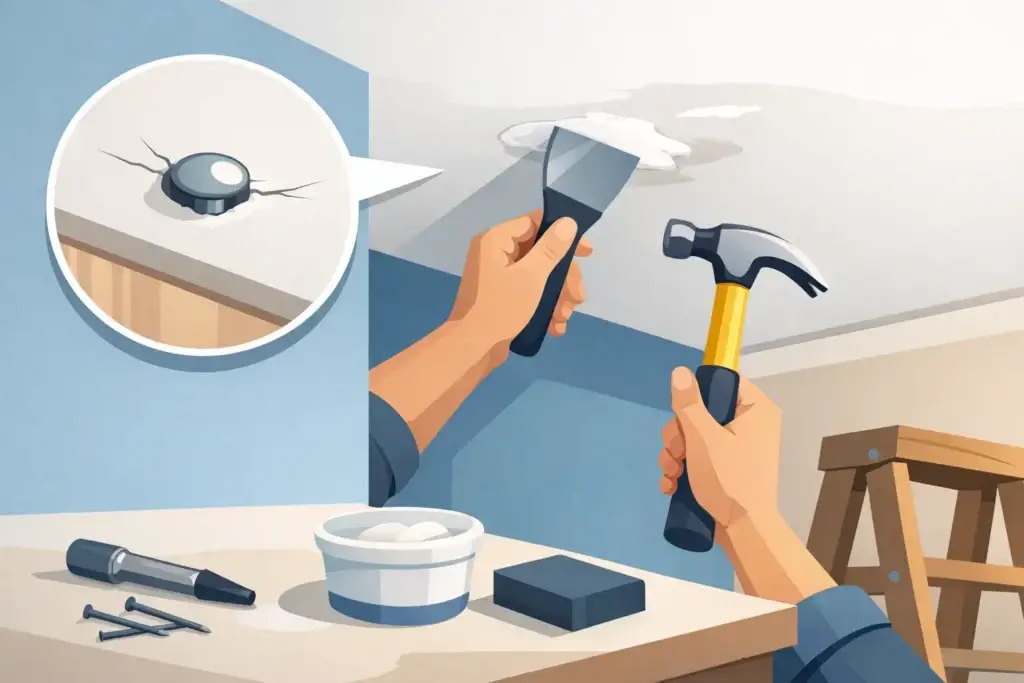
A small round bump in the wall can make an otherwise clean room look unfinished fast. If you are wondering how to fix nail pops, the good news is that most are repairable with basic drywall tools and a careful approach. The bigger question is whether you are dealing with a one-time cosmetic issue or a sign that the wall is still moving.
Nail pops happen when a drywall fastener pushes forward and breaks the surface of the joint compound or paint. Sometimes it is an old drywall nail working loose. Other times it is a drywall screw that was set poorly, framing lumber that shifted as it dried, or seasonal movement from humidity and temperature changes. In Oklahoma, those swings can be hard on walls and ceilings, especially in newer homes or spaces that have seen settling.
What causes nail pops in drywall?
Despite the name, not every nail pop involves a nail. Many homeowners use the term for any small raised spot or crack where a fastener sits under the drywall surface. The common thread is movement. When framing expands, contracts, or settles, the drywall can shift slightly against the fastener. That pressure breaks the finished surface and creates the bump or crack you see.
In older homes, true nails may loosen over time. In newer construction, fastener pops can show up as lumber dries out and shrinks a bit after installation. Ceilings are especially prone to this because gravity adds stress, and trusses can move differently than interior walls. If the pop is isolated and minor, the repair is usually straightforward. If you are seeing a pattern across several rooms, it may be worth having the drywall and framing looked at more closely.
How to fix nail pops step by step
The best repair is not just pushing the bump back in and covering it with spackle. That usually looks good for a short time, then reappears. A lasting repair secures the drywall again, removes the damaged material, and refloats the area so the finish blends in.
Start by checking the fastener
Press lightly around the popped area. If the drywall feels loose against the framing, the fastener has likely lost its hold. Use a utility knife to scrape away any loose paint or compound around the pop. Then identify whether there is a nail head or screw head beneath the surface.
If it is an old drywall nail, do not rely on simply hammering it deeper and calling it done. That can break the paper face further and weaken the hold. Instead, drive a drywall screw into the stud about 1 to 2 inches above or below the pop to secure the panel firmly. In some cases, adding one screw above and one below gives the best hold, especially on ceilings.
If the popped fastener is already a screw, it may be backing out or may have been set at the wrong depth. Tighten it carefully if it still bites into the framing. If it spins or will not seat properly, place a new drywall screw nearby into solid framing.
Deal with the old nail or screw correctly
Once the drywall is resecured, you can address the original pop. If it is a nail and it has pushed well forward, many pros prefer to tap it slightly back or remove it if practical after the new screw is in place. If you remove it, be gentle. Pulling too aggressively can damage the drywall face and create a bigger patch.
If it is a screw head that has broken the surface but still holds, you can set it slightly below the drywall surface without tearing the paper. That part matters. If you crush the paper face, the repair area gets weaker and may need more patching than expected.
Cut away loose material
Use your utility knife or a 5-inch drywall knife to remove cracked compound, flaking paint, and any broken paper around the pop. You want a clean, solid surface for the patch. This step is where many quick repairs go wrong. If loose material stays in place, the new compound has nothing reliable to bond to.
Keep the repair area as small as possible, but do not be afraid to widen it a little if the surrounding finish is already compromised. A clean shallow patch is easier to hide than a lumpy one.
Apply joint compound in thin coats
Use a quality joint compound and apply a thin first coat over the repair. Press firmly so the compound fills the damaged area and covers the fastener head. Let it dry fully before sanding lightly.
Apply a second coat wider than the first to feather the edges into the surrounding wall or ceiling. If needed, a third coat can help create a flatter finish, especially in areas where light hits at an angle. Thin coats take more patience, but they almost always look better than one heavy coat.
For textured walls or ceilings, matching the surrounding finish is the part that takes the most care. Light orange peel, knockdown, and hand texture each need a slightly different touch. If the repair is in a highly visible spot, texture mismatch can stand out more than the original nail pop.
Tools that make the repair easier
You do not need a full contractor setup to handle a small repair, but the right tools help. A utility knife, drywall screws, screw gun or drill, putty knife, joint compound, sanding sponge, and primer are usually enough. For ceilings, a sturdy ladder and good lighting matter more than people expect. You need to see the surface clearly to feather the patch well.
A note on materials: lightweight spackle can work for tiny cosmetic touch-ups, but standard joint compound is usually the better choice for a true nail pop repair. It feathers better and tends to blend more cleanly across a larger patched area.
When a nail pop is more than a cosmetic problem
Most nail pops are cosmetic, but not all of them should be brushed off. If you see repeated pops along a wall line, cracks at door corners, separation at ceiling joints, or doors that suddenly stick, there may be more going on than a loose fastener. Settlement, framing movement, moisture issues, or truss uplift can all show up through drywall finishes.
That does not always mean a major structural problem. It does mean the repair should be approached carefully. If movement is ongoing, the best drywall patch in the world may still crack again. In those cases, the right fix starts with identifying what is moving and why.
How to keep nail pops from coming back
If you want the best chance at a lasting result, securing the drywall panel is the key. Covering the bump without adding a screw nearby is the fastest way to end up doing the job twice. Proper screw placement gives the drywall a fresh hold against the framing so the patched area is not relying on old movement-prone fasteners.
It also helps to control indoor humidity as much as possible, especially during seasonal swings. That will not stop all drywall movement, but it can reduce expansion and contraction that stresses finished surfaces. In homes with chronic popping, ceilings and upper wall areas often deserve the closest inspection.
Should you repair it yourself or call a pro?
That depends on the location, the finish, and how visible the area is. A single nail pop on a flat wall in a spare bedroom is a reasonable DIY project if you are comfortable with basic patching. A ceiling repair in a main living area is less forgiving. Uneven sanding, flashing paint, or texture mismatch can make a small repair stand out from across the room.
If you have multiple pops, recurring cracks, or repairs tied to settling or framing movement, professional drywall repair is often the better value. A good repair should look clean, hold up well, and blend with the surrounding surface. That is especially important before listing a home, finishing a remodel, or maintaining a commercial property where appearance matters.
At KCS Drywall, this is the kind of work where experience pays off. Small drywall problems are easy to underestimate, but clean repairs take the same precision as larger jobs.
Nail pops are common, but they should not become something you keep staring at every time you walk into the room. Fix the cause, take your time with the finish, and the wall can look solid again.