
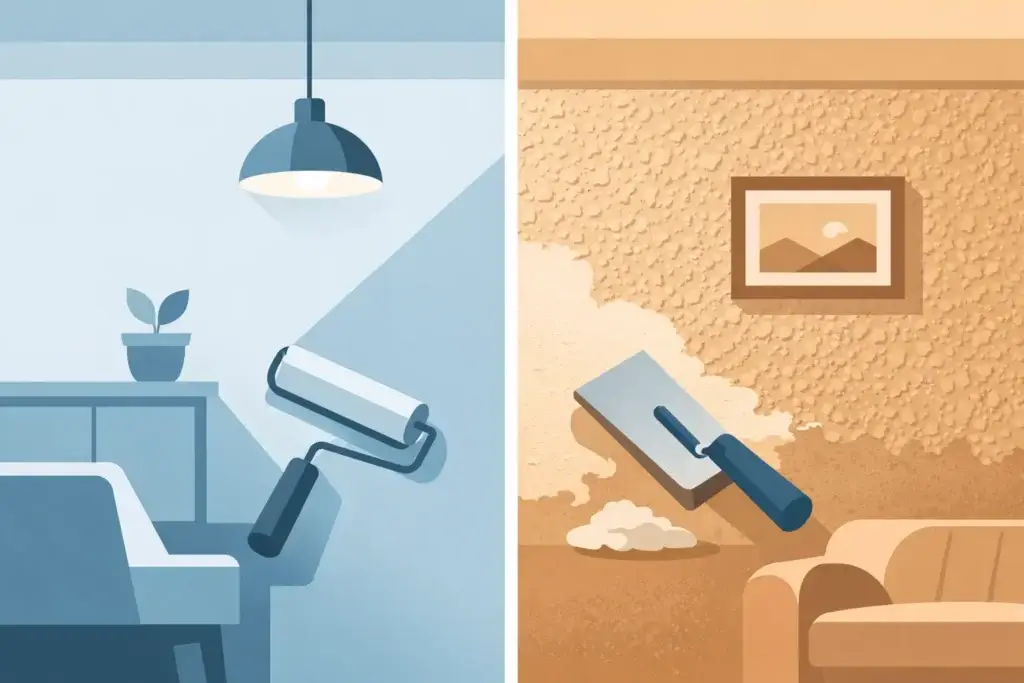
If you are planning drywall work, paint updates, or a full remodel, the choice between smooth walls vs textured walls affects more than looks. It changes how your space feels, how repairs show over time, how light moves across the room, and how much prep and maintenance your walls will need. For homeowners and property managers in Oklahoma, that decision also needs to hold up to real-life wear, shifting design trends, and the quality of the underlying drywall finish.
Why the finish matters more than most people think
Wall finish is one of those details people notice without always knowing why. A smooth wall gives a room a cleaner, more modern appearance. A textured wall adds visual variation and can help hide minor surface imperfections. Neither option is automatically better. The right choice depends on the age of the property, the look you want, the condition of the drywall, and how much future maintenance you are willing to take on.
This is where quality workmanship matters. A wall finish does not just sit on top of the drywall. It reveals or conceals what is underneath. If the framing is uneven, if seams are not finished correctly, or if repairs were rushed, a smooth finish will expose those flaws fast. Texture can be more forgiving, but it still needs to be applied evenly and with purpose.
Smooth walls vs textured walls: the main difference
At the simplest level, smooth walls have a flat, even surface with little to no visible pattern. Textured walls are finished with a deliberate pattern or sprayed surface that creates depth and breaks up the flat plane.
Smooth walls tend to feel current, bright, and refined. They are common in newer custom homes, updated interiors, offices, and spaces where a clean finish is the goal. Textured walls often feel more traditional and practical. In many homes, especially older ones, texture was used to speed up finishing, add character, or reduce the visibility of small drywall inconsistencies.
The difference is not only visual. Smooth walls usually require a higher level of drywall finishing and prep. Textured walls can reduce some labor at the finishing stage, depending on the texture type and the condition of the substrate. That can affect cost, timing, and long-term repair strategy.
When smooth walls make the most sense
Smooth walls are a strong fit when you want a crisp, updated interior. They work well in living rooms, kitchens, hallways, offices, and commercial spaces where a polished look matters. They also pair well with modern trim, strong natural light, and higher-end paint colors.
One of the biggest advantages of smooth walls is simplicity. The surface looks clean and straightforward. It lets flooring, cabinets, lighting, and furniture do the visual work instead of competing with wall pattern. If you are remodeling a home to feel newer or preparing a commercial space that needs a professional finish, smooth walls often support that goal.
Paint touch-ups can also be easier to blend on smooth walls if the color and sheen match. There is no texture pattern to recreate. Cleaning can be more direct too, especially in high-traffic areas where dust and grime tend to settle on raised surfaces.
The trade-off is that smooth walls are less forgiving. Poor taping, uneven patches, nail pops, and subtle framing irregularities can become visible, especially in rooms with strong side lighting. Smooth finishes require more precision from start to finish. If the prep is not right, the final result will show it.
When textured walls are the better choice
Textured walls still make a lot of sense in the right setting. If you are working with an older home, matching existing walls, or dealing with surfaces that are not perfectly uniform, texture can be a smart and practical finish. It helps disguise minor imperfections and can create continuity when repairs or additions are made.
Texture is also useful in busy homes and rental properties where walls take more abuse. Small scuffs, patch marks, and surface inconsistencies tend to be less obvious on a textured wall than on a smooth one. For some property owners, that makes texture easier to live with over time.
There is also a style factor. Not every home needs a sleek modern finish. Some interiors benefit from a little surface character, especially if the rest of the home has a more traditional or lived-in look. The key is making sure the texture feels intentional and consistent, not dated or uneven.
That said, texture can be harder to repair invisibly. Matching an existing texture pattern takes skill, and the patch can stand out if the application is off. Repainting can also require a little more material and effort because textured surfaces have more area to cover.
Cost, labor, and what usually drives the budget
Many people assume textured walls are always cheaper and smooth walls are always more expensive. Often that is true, but not in every case. The real cost comes from the condition of the walls, the level of finish required, and whether you are building new, repairing damage, or trying to match existing surfaces.
Smooth walls usually demand more prep. That can mean additional skim coating, sanding, priming, and inspection to make sure the surface is clean and uniform. In spaces with a lot of natural light, the standard may need to be even higher because light will reveal flaws quickly.
Textured walls can sometimes lower finishing labor because they do not require the same perfectly flat appearance. But if you are matching a specific texture during repairs, labor can increase. Some textures are simple to reproduce. Others take experience and a careful hand.
For Oklahoma property owners, the best approach is not to assume based on finish alone. The actual wall condition and the quality you expect should drive the estimate.
Maintenance and repair over time
This is where smooth walls vs textured walls becomes a practical decision, not just a design one. Every wall gets wear eventually. Furniture bumps corners. Kids leave marks. Settling can show up as cracks. Plumbing or electrical work may open sections of drywall.
Smooth walls are easier to wipe down and repaint evenly, but they show dents, waves, and patches more clearly. If damage happens, the repair has to be finished carefully so it disappears into the wall.
Textured walls hide everyday wear better, but matching repairs can be more complicated. If the original texture is heavy, patching may be straightforward. If it is a light or inconsistent pattern, blending it well takes experience. Poor texture repair is one of the quickest ways to make a wall look patched.
For commercial spaces, maintenance often comes down to traffic and speed. In some settings, a light texture can be a practical way to reduce the visibility of minor wear between paint cycles. In higher-end offices or customer-facing interiors, smooth walls may be worth the extra attention because of the cleaner presentation.
Style trends and resale considerations
In many updated homes, smooth walls are seen as the more current choice. They photograph well, fit modern interiors, and create a cleaner backdrop for trim, art, and fixtures. If you are remodeling with resale in mind, smooth walls can help a home feel fresher and more finished.
That does not mean texture automatically hurts value. A well-done textured finish that fits the home can still look good and perform well for years. Problems usually come from inconsistency, outdated heavy patterns, or poor repairs that make the finish look patched together.
If the rest of the house already has texture, switching one room to smooth may create a mismatch unless the remodel is broad enough to justify the change. Consistency matters. A whole-home finish strategy usually looks better than mixing wall styles room by room without a clear reason.
How to choose the right finish for your property
The best choice starts with a few honest questions. What condition are the existing walls in? Are you aiming for a modern update or trying to match what is already there? How important is easy repair versus a clean, high-end look? How much natural light hits the walls? And how long do you plan to stay in the property?
If you want a sharp, updated appearance and are willing to invest in proper prep, smooth walls are hard to beat. If you need a practical finish that blends with an older home or helps soften minor imperfections, texture may be the better fit.
In many projects, the answer is not based on trend alone. It is based on execution. A smooth wall only looks good when the drywall finish underneath is done right. A textured wall only looks good when the pattern is consistent and intentional. That is why the installer matters as much as the finish itself.
At KCS Drywall, we see this choice come up often during repairs, remodels, and new finish work across Oklahoma. The best results usually come from matching the wall finish to the space, the budget, and the long-term use of the property rather than chasing a one-size-fits-all answer.
If you are weighing smooth against textured walls, focus on what will look right in your space and hold up well after the crew leaves. The finish you choose should not just look good on day one. It should still make sense after paint, furniture, daily wear, and a few Oklahoma seasons have had their say.