
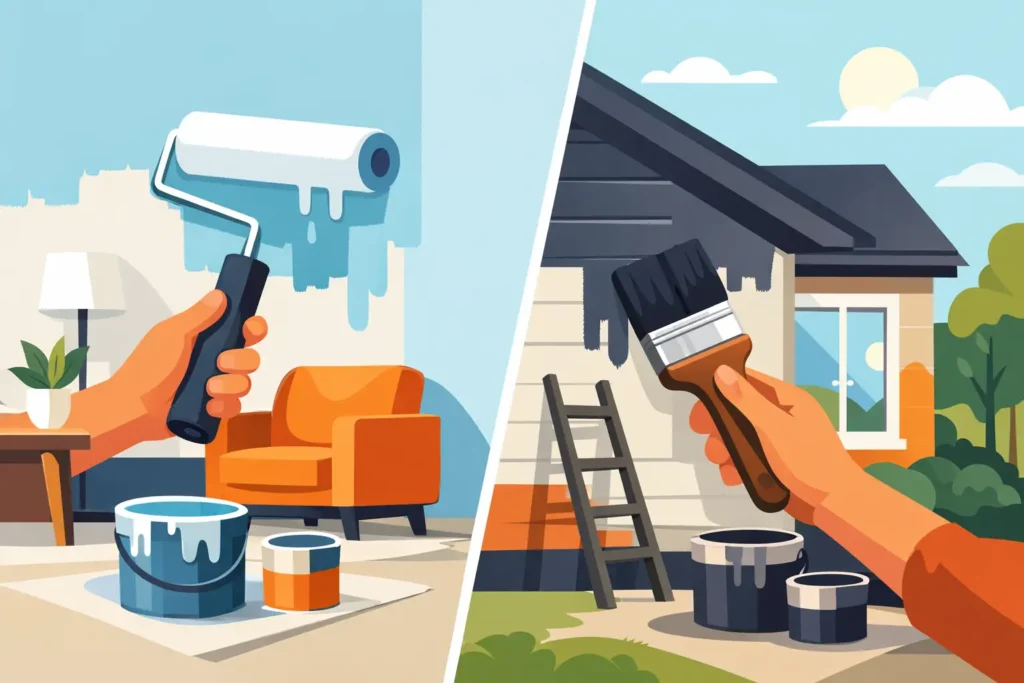
You usually notice the difference after the job is done wrong. A wall that should clean up easily starts scuffing. An exterior surface fades, peels, or chalks sooner than expected. That is usually when people start asking what makes interior and exterior paint different, and the answer goes well beyond the label on the can.
Interior and exterior paints are built for different conditions, different wear, and different expectations. While they can look similar going on, they are formulated to solve separate problems. If you are painting a living room, office, siding, trim, or a garage wall that deals with both humidity and temperature swings, using the right product matters for appearance, durability, and long-term value.
What makes interior and exterior paint different in practice
The biggest difference is what each paint has to withstand. Interior paint is made for controlled spaces. It needs to look smooth, resist everyday wear, and clean up well after fingerprints, furniture scuffs, or the occasional splash. Exterior paint is made to handle sun, rain, wind, dirt, temperature changes, and moisture over time.
That changes the formula. Exterior paint typically includes additives and flexible resins that help it expand and contract as outdoor surfaces heat up and cool down. It also needs stronger resistance to UV rays and moisture intrusion. Interior paint does not need to fight weather, so it is usually designed with more focus on finish quality, scrub resistance, and lower odor.
This is why interior paint used outside tends to fail early. It is not built to handle weather exposure. Exterior paint used inside can create its own problems too, especially if odor, surface feel, or indoor air quality are concerns.
Why the formula matters
Paint is not just color. It is a mix of binders, pigments, solvents, and additives, and each part affects performance.
Interior paint is built for finish and cleanability
Inside a home or commercial space, surfaces deal with contact more than climate. Hallways get bumped. Kitchens collect grease. Bathrooms deal with humidity. Bedrooms and living rooms need a clean, even appearance under artificial and natural light.
Because of that, interior paint is usually formulated to go on smoothly and leave a more refined finish. It is also made to resist staining and allow cleaning without wearing away too quickly. Better interior products are designed to hold their color and sheen while standing up to normal household use.
Many interior paints are also made with lower VOC content. That matters in occupied spaces where odor, ventilation, and indoor comfort are part of the job.
Exterior paint is built for movement and exposure
Outdoor surfaces are constantly under stress. Oklahoma homes and buildings see strong sun, storms, humidity swings, wind-driven dust, and rapid temperature changes. Siding, trim, stucco, brick, and other exterior materials expand and contract. Moisture tries to work its way in. UV exposure tries to break the finish down.
Exterior paint is made with that environment in mind. It needs to stay flexible longer, resist mildew and fading, and keep water from getting into the substrate while still allowing some surfaces to breathe. That balance is a big part of why exterior paint costs more and why it is not interchangeable with interior coatings.
What makes interior and exterior paint different for durability
Durability means different things indoors and outdoors.
Inside, durability usually means resistance to scuffs, stains, and repeated cleaning. A paint that holds up well in a family room may still fail outside because indoor durability does not equal weather resistance. On exterior surfaces, durability means resisting cracking, peeling, blistering, and color breakdown over time.
That is also why surface prep matters so much. Even the right paint will not perform well if it is applied over peeling layers, dirty surfaces, chalky siding, water-damaged trim, or poorly repaired drywall. Good results come from matching the product to the environment and applying it over a properly prepared surface.
Finish, sheen, and appearance
A lot of homeowners focus first on color, but sheen has a major effect on the final result.
Interior paints come in a wider range of finishes commonly used for design and function – flat, matte, eggshell, satin, semi-gloss, and gloss. Lower sheens can help hide minor drywall imperfections, while higher sheens tend to clean more easily and hold up better in higher-traffic areas.
Exterior paints also come in different sheens, but selection is usually more performance-driven. A completely flat exterior finish may hide flaws well, but it can sometimes hold dirt more easily. A slight sheen may improve washability and durability on trim or siding. The right choice depends on the surface condition, exposure, and the look you want.
If a wall has visible patches, texture transitions, or framing movement, sheen can make those flaws stand out. That is one reason experienced prep and finishing work matter as much as the paint itself.
Can you use exterior paint inside or interior paint outside?
Technically, you can apply the wrong product. Practically, it is usually a mistake.
Interior paint should not be used outside. It lacks the weather resistance needed for long-term exposure, and it will often fade, crack, or peel much sooner.
Exterior paint indoors is more of a gray area, but it is still not the best choice for most occupied spaces. Some exterior coatings have stronger fumes and are formulated with additives intended for outdoor conditions, not interior comfort. Even if they stick, that does not make them the right fit for bedrooms, offices, living areas, or commercial interiors.
There are specialty products for spaces like garages, covered patios, utility rooms, or masonry surfaces where conditions are less typical. That is where professional guidance helps. The right recommendation depends on how the space is used, how much ventilation it has, and what kind of wear the surface sees.
Where people get tripped up most often
One common mistake is assuming paint is paint as long as the color matches. Another is choosing solely by price. Lower-cost products can work fine for some applications, but if the surface is exposed to moisture, sunlight, repeated cleaning, or heavy traffic, the cheaper option can cost more in repainting and repairs.
Another issue is not accounting for the surface underneath. Drywall, wood, masonry, metal, and previously painted surfaces all behave differently. A bathroom wall does not need the same product as exterior trim. A stucco wall does not need the same coating as an interior office partition. The product has to match both the location and the material.
That is especially true on repair work. If drywall has been patched, skim coated, or textured, the finish coat needs to bond well and blend visually. If exterior wood has early signs of moisture damage, the right paint alone will not fix the problem unless the substrate is repaired first.
Choosing the right paint for your project
The best starting point is simple. Ask what the surface will face every day. If it is indoors, think about traffic, cleaning, humidity, and finish quality. If it is outdoors, think about sun, rain, temperature swings, and material movement.
For interior spaces, kitchens, bathrooms, hallways, and commercial common areas usually need more washability than low-traffic rooms. For exteriors, trim, siding, and doors often benefit from coatings selected specifically for that exposure level and substrate.
This is also where workmanship makes a real difference. Clean lines, proper patching, sanding, priming, and finish selection all affect how the paint looks and how long it lasts. At KCS Drywall, that attention to prep and finish is a big part of delivering results that hold up, not just results that look good on day one.
The real answer to what makes interior and exterior paint different
The real answer is performance under pressure. Interior paint is designed for people, traffic, and everyday living. Exterior paint is designed for weather, movement, and long-term exposure. They may sit next to each other on the shelf, but they are built for very different jobs.
When the right paint is matched to the right surface, the finish lasts longer, looks better, and creates fewer headaches down the road. If you are planning a repaint, repair, or remodeling project, it helps to treat paint selection as part of the build quality, not just the final color choice. A good finish starts with using the product that was made for the way your space actually lives.
https://shorturl.fm/00PUw
https://shorturl.fm/HYF2g
https://shorturl.fm/cROlW
https://shorturl.fm/uCX9J
https://shorturl.fm/fZadV
https://shorturl.fm/VQ9mD
Gonna try my luck at bdbld777 tonight. Heard some good things. Wish me luck! Go check it out. bdbld777
Pingback: Is Exterior Paint Better Than Interior? - KCS Drywall Company | Oklahoma’s Trusted Drywall & Remodeling Experts